The teňňe (plural: teňňe; symbol: t) is the official fractional monetary subunit of the Turkmenistan manat (TMT). Just as 1 US dollar equals 100 cents, 1 Turkmen manat equals 100 teňňe. Although small in value, the teňňe plays an essential role in Turkmenistan’s monetary structure and reflects the country’s political history, economic reforms, and national symbolism.
In this complete 2026 guide, we explore the history, denominations, design, economic relevance, and collector value of the teňňe in detail.
1. What Is the Teňňe? (Definition & Basics)
The teňňe is the coin-based subdivision of the Turkmenistan manat (TMT), the official currency of Turkmenistan, a Central Asian nation with a population of approximately 6 million people.
Key Facts at a Glance
-
Currency: Turkmenistan Manat (TMT)
-
Subunit: Teňňe
-
Conversion: 1 manat = 100 teňňe
-
Symbol: t
-
Form: Coins only (no teňňe banknotes)
-
Issuer: Central Bank of Turkmenistan
The name “teňňe” shares linguistic roots with other Central Asian currencies, including the Kazakh tenge, both derived from historical Turkic monetary terms.
2. History of the Teňňe
Post-Soviet Currency Reform (1993)
The teňňe was introduced on November 1, 1993, alongside the first Turkmen manat (TMM), replacing the Soviet ruble at a rate of:
1 manat = 500 rubles
This marked a critical step in Turkmenistan’s economic independence after the collapse of the Soviet Union.
Hyperinflation & Redenomination (2009)
During the 1990s, Turkmenistan experienced extreme hyperinflation, reaching thousands of percent annually.
To stabilize the economy, the government introduced a redenomination in 2009:
1 new manat (TMT) = 5,000 old manats (TMM)
Importantly, the teňňe remained the subdivision under the new currency system.
US Dollar Peg
Since January 1, 2015, the Turkmen manat has been pegged to the US dollar at:
1 USD = 3.50 TMT
From 2009 to 2015, the peg stood at 2.85 TMT per USD.
Although the official exchange rate is fixed, unofficial market rates have sometimes diverged due to currency controls and limited convertibility.
3. Teňňe Coin Denominations (2026 Circulation)
Teňňe exists exclusively in coin form. No banknotes are issued in teňňe denominations; paper currency begins at 1 manat.
Current Coins (Introduced 2009 Reform)
| Denomination | Material | Diameter | Weight | Edge | Year Issued |
|---|---|---|---|---|---|
| 1 teňňe | Nickel-plated steel | 16 mm | 2.4 g | Plain | 2009 |
| 2 teňňe | Nickel-plated steel | 18 mm | 3.2 g | Plain | 2009 |
| 5 teňňe | Nickel-plated steel | 20 mm | 4.0 g | Plain | 2009 |
| 10 teňňe | Brass | 22 mm | 5.0 g | Reeded | 2009 |
| 20 teňňe | Brass | 24 mm | 6.0 g | Reeded | 2009 |
| 50 teňňe | Brass | 26 mm | 7.0 g | Reeded | 2009 |
Circulation Trends
-
1, 2, and 5 teňňe coins are rarely used due to their low purchasing power.
-
10, 20, and 50 teňňe coins are more commonly circulated.
-
All coins are minted by the Royal Mint (United Kingdom).
Pre-2009 Coins
The 1993 series included cupronickel coins (1–50 teňňe), many featuring President Saparmurat Niyazov (Turkmenbashi). These coins were demonetized after 2009.
4. Design & Symbolism of Teňňe Coins
Turkmenistan’s currency design strongly reflects national identity and political philosophy.
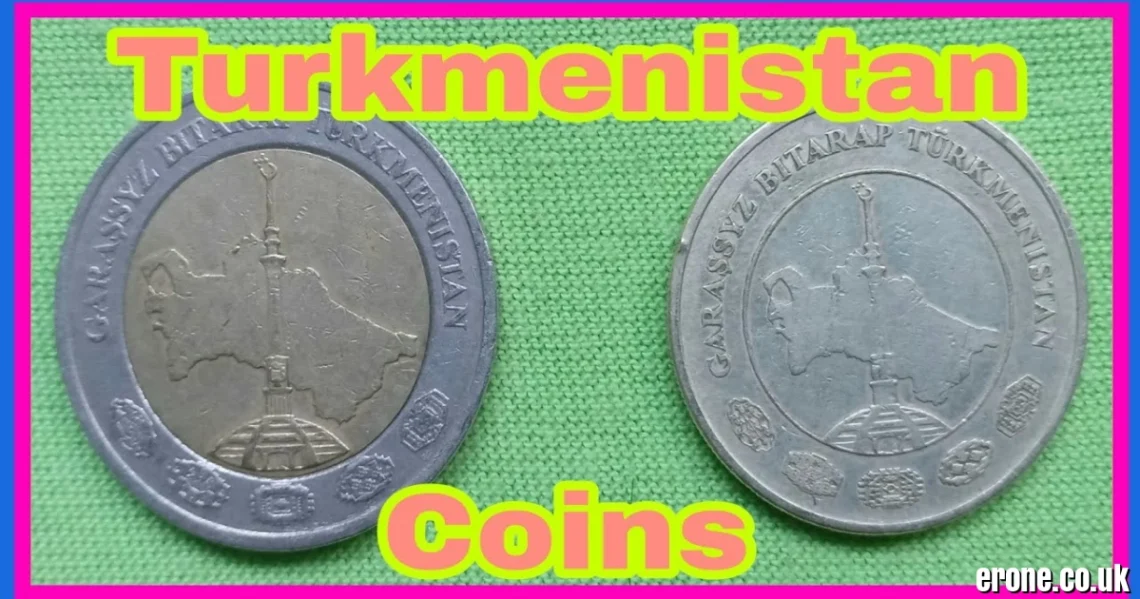
Obverse Design
Modern coins feature:
-
A map of Turkmenistan
-
The Independence Monument in Ashgabat
-
Inscription:
“GARAŞSYZ BÝTARAP TÜRKMENISTAN”
(“Independent Neutral Turkmenistan”)
This slogan references Turkmenistan’s official policy of permanent neutrality, recognized by the United Nations in 1995.
Reverse Design
The reverse side displays:
-
The denomination (e.g., “10 TEŇŇE”)
-
Decorative elements like wheat ears, stars, and national motifs symbolizing prosperity and unity
Political Evolution in Design
-
Pre-2009: Featured President Niyazov’s portrait.
-
Post-2009: Shifted toward neutral state symbols under President Gurbanguly Berdimuhamedow.
-
Current designs emphasize national identity rather than individual leadership.
5. Relationship Between Teňňe & Manat Banknotes
While teňňe coins handle small-value transactions, manat banknotes serve larger purchases.
Current Manat Banknote Denominations
-
1 manat
-
5 manat
-
10 manat
-
20 manat
-
50 manat
-
100 manat
-
200 manat
-
Rare 500 manat
Polymer Banknotes (2025 Update)
In 2025, Turkmenistan introduced polymer versions of the 1, 5, 10, and 200 manat notes to commemorate the 30th anniversary of permanent neutrality.
These polymer notes offer:
-
Enhanced durability
-
Advanced security features
-
Improved resistance to counterfeiting
Banknotes often feature historical figures such as:
-
Oguz Khan
-
Magtymguly Pyragy
Alongside architectural landmarks like the Rukhiyet Palace.
6. Teňňe in the Modern Economy (2026 Perspective)
Economic Context
Turkmenistan’s economy relies heavily on:
-
Natural gas exports
-
State-controlled industries
-
Fixed exchange rate policy
Despite modernization efforts, cash transactions remain dominant, especially in smaller cities and rural areas.
Convertibility & Market Reality
Although officially pegged to the US dollar:
-
The manat (and therefore teňňe) has limited international convertibility.
-
A black market exchange rate has historically differed from the official rate.
This affects foreign exchange access but does not eliminate everyday domestic use of teňňe coins.
Collector Value
Teňňe coins attract attention from numismatists (coin collectors) worldwide.
-
Uncirculated examples typically sell for $1–$5 USD
-
Rare early 1993 coins can command higher prices
-
Available on platforms like Numista and eBay
Collectors often value the coins for their:
-
Unique national symbolism
-
Political transition history
-
Royal Mint production quality
Frequently Asked Questions (FAQs)
What does “teňňe” mean?
It refers to the subunit of the Turkmen manat, similar to “cents” in the US dollar system.
Is teňňe still used in 2026?
Yes, though lower denominations are less common in daily transactions.
Are there teňňe banknotes?
No. Teňňe exists only as coins.
Who mints teňňe coins?
The Royal Mint in the United Kingdom.
Can teňňe be exchanged outside Turkmenistan?
Generally no, as the manat has limited international convertibility.
Conclusion
The teňňe may be a small monetary unit, but it represents an important piece of Turkmenistan’s economic history and national identity. From its introduction in 1993 during post-Soviet reforms to its redesign in 2009 and continued use under a dollar peg, the teňňe reflects the country’s evolving financial system.
In 2026, it remains:
-
A functioning currency subdivision
-
A symbol of national neutrality
-
A collectible artifact for numismatists
Whether viewed from an economic, political, or historical perspective, the teňňe offers valuable insight into Central Asian monetary development in the post-Soviet era.