Uncategorized
I Believe I Can / I Believe I: The Power of Self-Belief


Belief has always been at the heart of human motivation. When someone says “I believe I can”, they are making a declaration of hope, possibility, and faith in their own potential. But what does such a statement really mean? How has it resonated across art, psychology, and everyday life? In this article we explore the many facets of “I believe I can / I believe I” — from songs to mindset, from evidence to critique — to understand why this phrase carries so much weight.
The Origins & Cultural Resonance of “I Believe I Can Fly”
One of the most iconic uses of the “I believe I can” motif is the song “I Believe I Can Fly” by R. Kelly. Released in 1996 as part of the Space Jam soundtrack, the song transcended its era and became an anthem of aspiration, faith, and transcendence.
Composition & Success
-
The song was written, produced, and performed by R. Kelly.
-
It achieved global chart success: reaching number 2 on the Billboard Hot 100, and topping the U.S. R&B chart for six non-consecutive weeks.
-
It won multiple Grammy awards and has been ranked among the 500 Greatest Songs of All Time by Rolling Stone.
Why It Resonates
What makes “I Believe I Can Fly” so enduring is its combination of personal vulnerability and uplifting promise. The lyrics are simple yet evocative, speaking to the desire to break free — to soar beyond limits. This is exactly the sort of message that fuses with human emotion, making listeners feel a connection to their own hopes.
Because of its popularity and emotional impact, the song has influenced how many people internalize “I believe I can” as more than just words — a mantra for overcoming obstacles.
“I Believe I” Beyond the Song: Varied Interpretations
While “I Believe I Can Fly” is the most famous use of this motif, variants like “I believe I” or “I believe I can / I believe I will” appear in songs, speeches, and self-help rhetoric. Let’s explore some interpretations.
In Music & Pop Culture
Musicians often use “I believe I” to express inner conviction in love, change, or identity. (Though not an exact match, songs like DJ Khaled’s “I Believe” carry a similar message of self-belief and faith.)
In Motivation & Self-Help
In motivational literature and seminars, the phrasing “I believe I can” or “I believe I will” is used as a positive affirmation. It’s meant to shift mindset from doubt to possibility. The idea is: what you believe has power to shape your actions, which in turn shape your outcomes.
In Psychology
From a psychological perspective, self-efficacy (a person’s belief in their ability to succeed in specific situations) is closely related. When someone says “I believe I can,” they’re exercising or reinforcing their self-efficacy. That self-belief is often a predictor of perseverance, resilience, and goal achievement.
6 Key Dimensions When Someone Says “I Believe I Can / I Believe I”
Let’s dig deeper into six important dimensions or lenses through which we can understand this phrasing.
1. Mindset & Identity
When you say “I believe I can,” you’re not just making a statement about a task — you’re shaping your identity. It implies that you see yourself as capable, worthy, and deserving. This internal narrative influences how you approach challenges.
2. Motivation & Persistence
Belief fuels motivation. If you believe you can succeed, you are more likely to persist in the face of obstacles. It becomes a self-fulfilling prophecy: belief → action → results → reinforced belief.
3. Emotional Regulation
Expressing “I believe I can” can help regulate emotions — anxiety, fear, stress — by turning attention toward possibility rather than limitation. It helps redirect focus from what could go wrong to what could go right.
4. Social & Cultural Framing
Societies often celebrate the “believer” — the one who has faith in themselves, against all odds. The phrase “I believe I can” taps into many cultural narratives: the hero’s journey, underdog stories, religious or spiritual faith. It’s a phrase that resonates widely.
5. Critique & Overconfidence
Of course, belief without realism can be risky. If someone believes “I can” in the absence of adequate skill or preparation, they may face serious setbacks. In other words, belief must often be tempered with self-awareness, humility, and effort.
6. Growth & Adaptability
A healthy “I believe I can” is not rigid. It evolves. Belief should adapt: “I believe I can improve, I believe I can learn, I believe I can adjust.” That kind of dynamic belief supports long-term growth.
How to Harness “I Believe I Can / I Believe I” Effectively
Belief is powerful — but how do we use it wisely? Here are actionable ways to harness it in daily life.
1. Use Affirmations Mindfully
Rather than just repeating “I believe I can,” pair it with concrete goals, plans, and time frames. For example: “I believe I can complete my course by June 30, and I will study two hours daily.”
2. Visualize the Process, Not Just the Outcome
When you say “I believe I will succeed,” visualize the steps it will take, not just the end result. This builds mental rehearsal and prepares you to navigate obstacles.
3. Track Small Wins
Belief becomes stronger when you see evidence. Break your goal into micro-milestones and celebrate them. Each completed step reinforces “I believe I can.”
4. Surround with Believers
Your belief is reinforced by social support. Be around people who also say “I believe I can,” who encourage you, and who validate your journey.
5. Learn from Failures
When things don’t go as planned, don’t let belief collapse. Instead say: “I believed I could, and I learned that I need to adjust. Now I believe I can with this new plan.” That kind of resilience is key.
Case Studies & Examples of “I Believe I Can / I Believe I” in Action
Let’s look at a few real-world cases where the phrase or its spirit played a transformative role.
1. Olympians & Athletes
Many athletes use the phrasing “I believe I can” as a mental reframing before competition. Whether in sports psychology or coaching, affirmations of ability help shift focus from fear of failure to confidence in performance.
2. Education & Learning
Students who adopt “I believe I can learn this subject” often outperform peers who say “I can’t.” The growth mindset pioneered by Carol Dweck echoes exactly that belief: intelligence and skill are not fixed, and saying “I believe I can grow” becomes a powerful self-fulfilling principle.
3. Entrepreneurship & Startups
Entrepreneurs frequently operate in high uncertainty. Belief in vision is often what carries them through initial struggles when profits aren’t yet visible. The mantra “I believe I can build something meaningful” sustains energy when external validation is lacking.
4. Personal Transformation
In stories of recovery, change, or transformation (health, addiction, relationships), many testimonials use “I believed I could turn around” as a turning point. That belief often precedes the meaningful action that changes life.
Potential Criticisms & Balanced View
While powerful, “I believe I can” is not a panacea. It’s important to maintain a balanced view.
-
Belief without action is useless. Saying “I believe I can” but not doing the work leads nowhere.
-
Overconfidence risk: If belief overshoots realistic assessment, one may take on tasks beyond capacity, leading to burnout or failure.
-
Psychological blind spots: Some limitations—like structural barriers, lack of resources, societal constraints—cannot be overcome just by belief.
-
Neglect of process: Focusing too much on belief might devalue the importance of strategy, skill development, planning, and external support.
Thus the healthiest posture is: “I believe I can, and I will do what it takes to prove it” — pairing belief with humility, effort, adaptability, and realism.
Conclusion
The phrase “I believe I can / I believe I” is more than just motivational fluff. It captures the essence of hope, identity, aspiration, and action. From R. Kelly’s soaring anthem “I Believe I Can Fly” to everyday affirmations, this phrase speaks to our deepest human need: to transcend limitations.
But the power doesn’t lie in words alone — it lies in what you do next. Belief must be coupled with consistency, self-awareness, strategy, and resilience. Used wisely, “I believe I can” becomes a mantra that ignites transformation. Used naively, it risks being empty.
So the next time you catch yourself thinking “I believe I can,” pause and ask: What will I do today to make that belief real? That is where true growth lives.
Uncategorized
Slot Gacor Teshoki.maxwin (2026 Guide – US): Meaning, Legality, and Risks of “Gacor Slot” Platforms

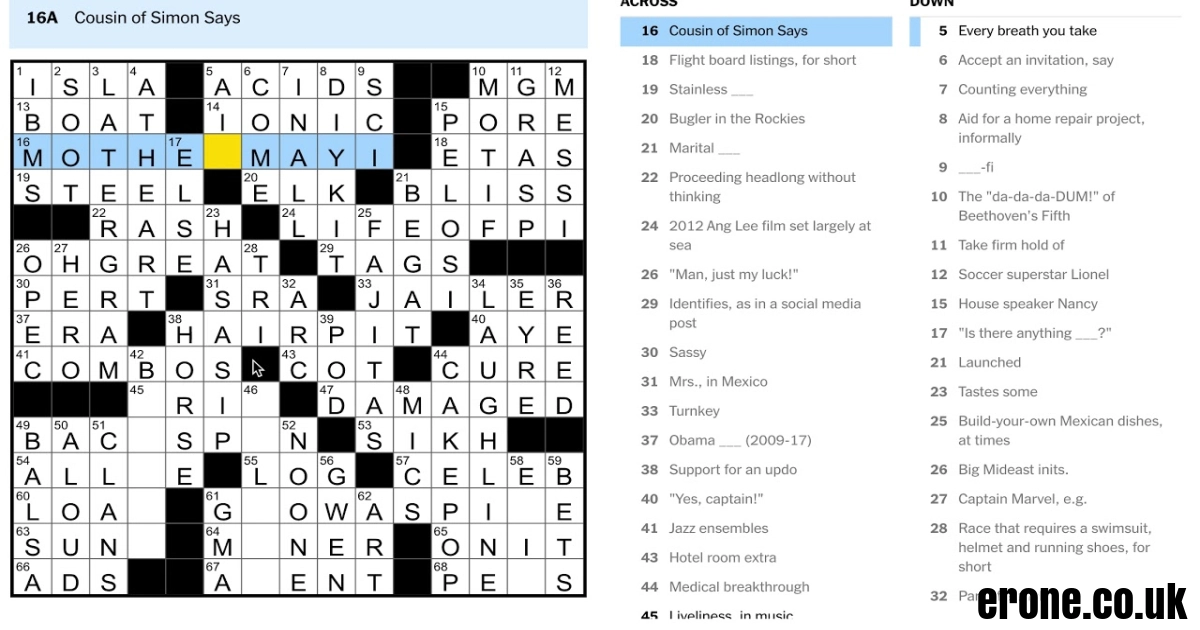
“Recently Dated NYT Crossword”, you’re likely looking for the answer, the explanation, or the full puzzle breakdown from the August 28, 2025 New York Times Crossword (published August 27, 2025). This puzzle quickly became a favorite among US solvers thanks to its clever Spoonerism theme, clean grid, and satisfying “aha!” moments.
As of February 27, 2026, this puzzle is still considered one of the most memorable Thursday crosswords of 2025. Whether you’re checking an answer, studying the theme, or improving your solving skills, this complete guide will walk you through everything you need to know.
What Does “Recently Dated” Mean in the NYT Crossword?
The clue “Recently dated” appeared at 17-Across in the August 28, 2025 puzzle. On the surface, it sounds like it refers to a romantic relationship. Maybe someone who just started dating? That’s the trap.
The correct answer is:
GOOD ENOUGH
But why?
Because this puzzle uses a Spoonerism theme.
The Spoonerism Explanation
“Recently dated” is actually a Spoonerism of:
Decently rated
When you swap the starting consonant sounds:
- Re-cently da-ted
- becomes
- De-cently ra-ted
And what does “decently rated” mean?
It means something is good enough.
That’s the brilliance of the clue. It’s not about romance at all — it’s about wordplay.
If you’re new to Spoonerisms, this puzzle was an excellent introduction to the concept, and many US solvers called it one of the most accessible Thursday themes of the year.
Puzzle Overview – August 28, 2025 NYT Crossword
Here’s a snapshot of the full puzzle:
- Date: August 28, 2025
- Published: August 27, 2025
- Constructor: Joel Woodford (debut!)
- Editor: Will Shortz
- Grid Size: 15×15
- Difficulty: Easy-Medium (typical Thursday trickiness)
- Theme Revealer: 66-Across – SPOONERISM
This puzzle was considered “recently dated” in the literal sense too — as of February 2026, it’s about six months old, still fresh in crossword discussions.
Why This Puzzle Stood Out
- Clean fill (no rebus squares)
- Simple consonant swaps in clues only
- Accessible theme execution
- Great mix of pop culture and classic crossword entries
Many Reddit users on r/crossword reported average solve times of 10–15 minutes, which is slightly faster than a typical Thursday.
The Spoonerism Theme Explained (All Themed Entries)
The genius of this crossword lies in how the clues are Spoonerized — not the answers.
Here are the four themed entries:
| Position | Spoonerism Clue | Answer | Original Phrase Meaning |
|---|---|---|---|
| 17A | Recently dated | GOOD ENOUGH | Decently rated |
| 25A | No guts | FREAK OUT | Go nuts |
| 41A | Battle carriers | CHAIN LINK FENCES | Cattle barriers |
| 52A | Packed lunch | FELL FLAT | Lacked punch |
Each clue sounds slightly “off” until you say it aloud and swap the first sounds.
For example:
- Packed lunch
- Swap sounds → Lacked punch
- Which means → Fell flat
That subtle shift creates a satisfying mental click.
Full Across Clues & Answers (Spoilers Included)
Here is the complete Across list for US solvers who want to check their grid:
| # | Clue | Answer |
|---|---|---|
| 1 | “Table” for one’s TV dinner, perhaps | LAP |
| 4 | Messy abode | STY |
| 10 | Texting format, in brief | SMS |
| 13 | Period that begins with a day of pranks: Abbr. | APR |
| 14 | Weakness | ANEMIA |
| 15 | ___ Highway (Maui tourist attraction) | HANA |
| 17 | Recently dated | GOODENOUGH |
| 19 | Many a citizen of Abu Dhabi | EMIRATI |
| 20 | It’s used for wrapping up a film | CELLOPHANE |
| 21 | Gained a wider following | TRENDED |
| 22 | Riddled (with) | RIFE |
| 23 | Top up | REFILL |
| 25 | No guts | FREAKOUT |
| 27 | Where someone might ask for a screwdriver | BAR |
| 29 | Early tech giant | ATARI |
| 31 | Fair Deal prez | HST |
| 32 | Like Frodo at the end of LOTR | ASEA |
| 34 | Chaps | LADS |
| 37 | Poem that’s typically unrhymed | HAIKU |
| 41 | Battle carriers | CHAINLINKFENCES |
| 44 | Mythological beast able to regenerate heads | HYDRA |
| 45 | Commuter option | RAIL |
| 46 | Non-fruit ingredient in a green smoothie | KALE |
| 47 | One of three in the Domino’s logo | PIP |
| 49 | Syllable akin to “Tsk!” | TUT |
| 51 | Audiophile’s collection | LPS |
| 52 | Packed lunch | FELLFLAT |
| 57 | Wail | KEEN |
| 59 | Shade in a picturesque island scene | AZURE |
| 60 | Follower of Joel | AMOS |
| 62 | Here’s the scoop! | LADLE |
| 65 | Colossally bad consequence | RUIN |
| 66 | Feature of themed clues | SPOONERISM |
| 68 | Wizard | ACE |
| 69 | Some underground networks | ROOTSYSTEMS |
| 70 | “Kapow!” | BAM |
| 71 | Fleur-de-___ | LIS |
| 72 | Follow, with “to” | ADHERE |
| 73 | “Come ___?” (Italian greeting) | STA |
Why US Solvers Loved This Puzzle
Let’s be honest: Thursday puzzles can sometimes feel intimidating. Rebus squares, trick answers, strange gimmicks — it can get messy.
But this one felt fair.
What Worked Well
- No complex grid manipulation
- Theme revealed clearly at 66A
- Clean, lively fill (SMURF, HYDRA, ATARI)
- A satisfying payoff once theme clicked
Notable Down Entries
- YAHWEH (9D) – Fresh, strong fill
- SHARK TANK (10D) – Contemporary pop culture
- LUIGI & MARIO (54D & 11D) – Fun pairing
- ASHE (26D) – Important sports history reference
It blended classic crossword feel with modern energy.
How to Solve Spoonerism Clues Like a Pro (2026 Strategy Guide)
If you got stuck on “recently dated,” don’t worry — you’re not alone. Spoonerisms are tricky until you train your brain.
Here’s how to crack them faster:
1. Say the Clue Out Loud
Sound matters more than spelling. Hearing it helps you detect swapped consonants.
2. Swap First Sounds
Focus only on the first consonant sounds of each word.
Example:
- Battle carriers
- Swap → Cattle barriers
3. Think Definition, Not Literal Meaning
The clue’s literal meaning is usually wrong.
Instead, think:
“What phrase sounds similar and actually makes sense?”
4. Fill Cross Letters First
Crossword solving is rarely linear. Fill shorter Across and Down clues first, then revisit the themed entry.
Accessing the NYT Crossword in 2026 (US Market Guide)
If you want to solve this puzzle yourself:
Subscription Options
- NYT Games App (iOS/Android)
- Full archive access (~$6.99/month)
- Annual plan (~$40/year)
Free Options
- Daily Mini Crossword (free)
- Limited previews
For archive solving, this puzzle can be found in the August 2025 section.
Is the “Recently Dated” Clue Still Relevant in 2026?
Absolutely.
Crossword enthusiasts revisit strong theme puzzles for:
- Study practice
- Constructor inspiration
- Teaching examples
- Thematic analysis
Joel Woodford’s debut puzzle is now often referenced as a model Thursday execution — especially for new constructors trying Spoonerisms.
It’s clever without being punishing.
And that’s rare.
Conclusion: Why “Recently Dated” Is a Crossword Gem
The “recently dated” NYT crossword clue is more than just an answer — it’s a perfect example of how clever wordplay can elevate a puzzle from good to unforgettable.
The answer GOOD ENOUGH feels simple once you see it. But getting there requires:
- Sound awareness
- Pattern recognition
- A willingness to rethink the clue
That moment when the theme clicks? That’s why we keep solving.
If you love Thursday puzzles, this one is worth revisiting in the archive. It’s playful, fair, and brilliantly constructed — everything a strong NYT crossword should be.
FAQs About Recently Dated NYT Crossword
1. What is the answer to “Recently dated” in the NYT Crossword?
The answer is GOOD ENOUGH, based on a Spoonerism of “decently rated.”
2. What date was this puzzle published?
It appeared in the August 28, 2025 New York Times Crossword (published August 27, 2025).
3. What is a Spoonerism in crosswords?
A Spoonerism swaps the initial consonant sounds of two words to create a new phrase, often humorous or misleading.
4. Who constructed this puzzle?
It was constructed by Joel Woodford and edited by Will Shortz.
5. How can I access older NYT crossword puzzles?
Subscribe to the NYT Games app or visit nytimes.com/crosswords to access the full archive.
The question “is Hovaswez496 safe to use” has seen a noticeable rise in searches in 2026. Users across forums, blogs, and search engines are trying to understand what Hovaswez496 is, whether it poses security or health risks, and if it can be trusted. The lack of clear official documentation has only increased curiosity and concern.
This fully informative, 2026-focused article breaks down everything currently known about Hovaswez496, highlighting important safety facts in bold, and explaining what users should do before interacting with it.
What Is Hovaswez496? Understanding the Term Clearly
As of 2026, Hovaswez496 is not recognized as a standard product, software, medication, or officially registered service in major regulatory databases. Instead, it appears online as a non-mainstream or obscure identifier, often mentioned in safety-related searches.
Based on available information, Hovaswez496 may refer to:
-
A newly branded digital tool or application
-
A test or placeholder name used in experimental environments
-
A potential third-party software or online service
-
A term circulating through SEO-driven or automated content
Because there is no authoritative source clearly defining its purpose, users should approach Hovaswez496 with caution.
Is Hovaswez496 Safe to Use According to Online Reports?
When analyzing online discussions and articles, a consistent theme emerges: there is no verified proof that Hovaswez496 is safe.
Key Safety Observations
-
No official certification or regulatory approval
-
No transparent developer or manufacturer details
-
No published security audits or testing results
-
Safety claims are unverified
This does not automatically mean Hovaswez496 is harmful, but it does mean its safety cannot be confirmed. In cybersecurity and consumer safety, lack of evidence is a major red flag.
Potential Risks Associated With Hovaswez496
Because Hovaswez496 lacks documented validation, several potential risks should be considered—especially if it is a digital product or downloadable resource.
Possible Risk Factors
-
Malware or spyware exposure
-
Data privacy violations
-
Unauthorized system access
-
Hidden background processes
-
Unclear data collection practices
If Hovaswez496 is software-related, installing or running it without verification could expose devices to security vulnerabilities or data leaks.
Why Is Hovaswez496 Being Searched So Frequently in 2026?
The surge in searches for “is Hovaswez496 safe to use” can be attributed to modern online behavior.
Main Reasons
-
Encountering the name through pop-ups or redirects
-
Seeing it referenced in low-authority blogs
-
Curiosity about unfamiliar digital terms
-
Fear of unknown files or applications on devices
Search engines often amplify queries when a term lacks clarity, creating a feedback loop of curiosity and concern.
What To Do If You Encounter Hovaswez496
If you come across Hovaswez496—whether as a file, app, link, or service—caution is the best approach.
Recommended Safety Steps
-
Do not install or run it immediately
-
Scan related files with reputable antivirus software
-
Avoid granting permissions or access
-
Research the source and developer thoroughly
-
Remove it if it serves no clear purpose
In 2026, cybersecurity experts emphasize zero-trust behavior toward unknown or undocumented tools.
Expert Recommendations and Best Practices
Without verified information, experts generally advise avoiding unconfirmed products like Hovaswez496 until more transparency is available.
Best Practices
-
Use only well-documented and trusted software
-
Check for official websites and verified reviews
-
Avoid tools lacking clear privacy policies
-
Prioritize digital safety over curiosity
Until Hovaswez496 is backed by credible research, audits, or regulatory approval, using it carries unnecessary risk.
Conclusion
So, is Hovaswez496 safe to use in 2026? Based on available information, its safety cannot be confirmed. With no official documentation, testing data, or regulatory approval, Hovaswez496 remains an unknown and potentially risky entity. The safest decision is to avoid using it until reliable, transparent information becomes available. When it comes to digital or personal safety, certainty matters more than convenience.
Frequently Asked Questions (FAQs)
1. Is Hovaswez496 officially approved for use?
No, there is no known official approval or certification.
2. Is Hovaswez496 malware?
There is no confirmed classification, but unknown tools can pose risks.
3. Should I delete Hovaswez496 if I find it on my device?
Yes, especially if it appeared without your knowledge.
4. Why does Hovaswez496 appear online?
Likely due to experimental naming, SEO content, or third-party distribution.
5. Is it safe to ignore Hovaswez496 completely?
Yes. Avoidance is the safest option until verified information exists.


HUAWEI gt 7: Smart Training for Every Outdoor Adventure

The Tech in Your Home is More Advanced Than You Think – Does It Truly Preserve Your Valuables?